
The emergency waiting room at 11 PM is not the place to explain what MDR1 means to a technician who has never heard of it, while your dog is trembling on an exam table. That conversation has to happen before the crisis, in a form that can be communicated instantly, understood without prior knowledge, and accessed even when you are too frightened to think clearly.
Over twenty years of emergency veterinary toxicology, I have watched MDR1 information arrive in every form imaginable. Sometimes owners know their dog's status and communicate it clearly. More often, the information comes out after a treatment decision has already been made — sometimes after the wrong treatment has already been given. The gap between knowing your dog's MDR1 status and communicating it effectively at the emergency clinic is where preventable harm occurs.
Why Emergency Clinic Communication Is Different
Your regular veterinarian knows your dog. They have the MDR1 test result in the file. They have treated your dog for years and have internalized the medication constraints. Emergency clinics operate under completely different conditions. The staff may have never seen your dog. They are working under time pressure. They may have limited access to your dog's medical records, particularly if you use a different primary care clinic. They may be managing multiple critical patients simultaneously.
In this environment, communication must be fast, clear, and impossible to miss. Information that requires explanation, context, or technical knowledge to act on is information that may not be acted on correctly. The emergency clinic is not the right setting for a nuanced discussion of P-glycoprotein function. It is the setting for a clear, immediate alert that stops dangerous medications before they are administered.
The MDR1 Alert Card: Your Dog's Most Important Piece of Paper
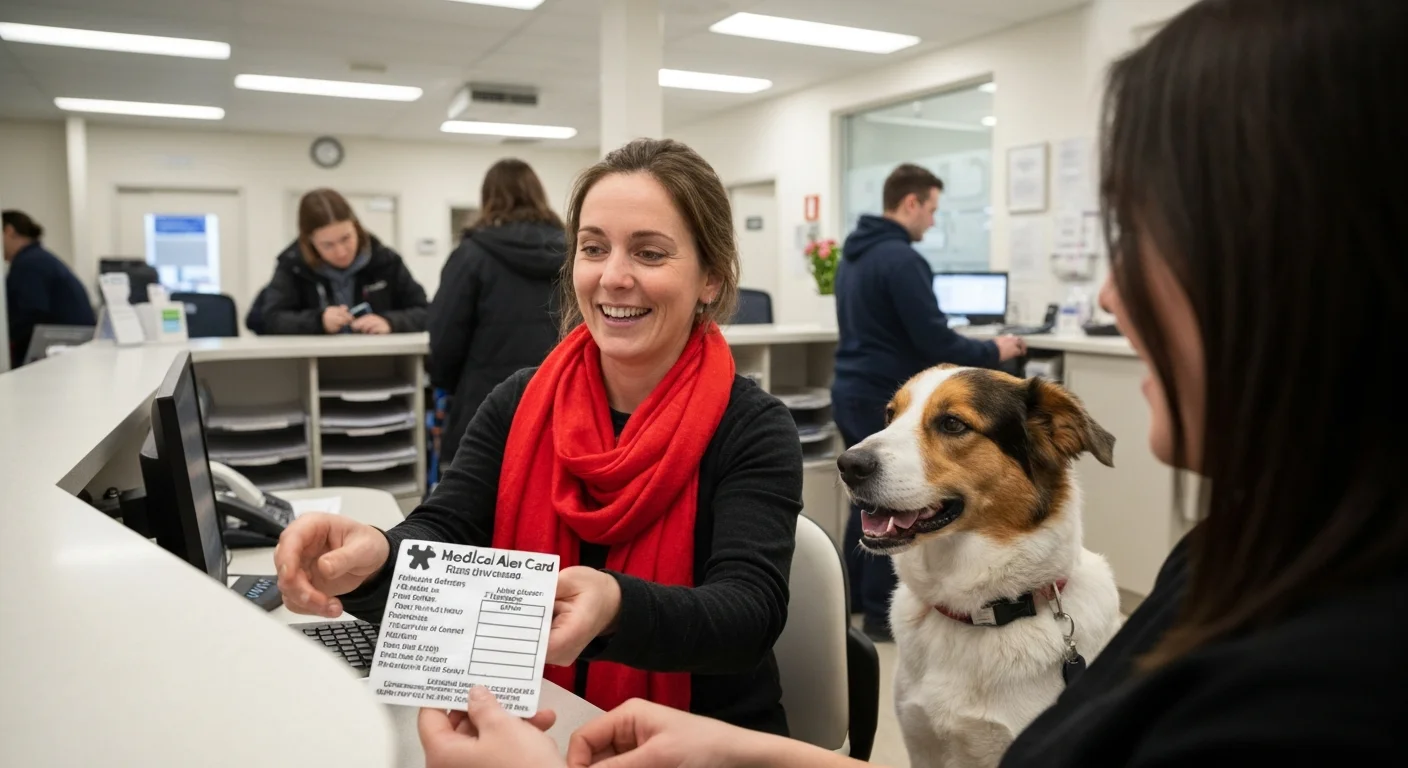
Every owner of an MDR1-affected dog should carry a small, laminated card that can be presented at any veterinary facility. This card should state the dog's name, the MDR1 status (carrier or affected, with specific genotype if known), and the key medications to avoid. It should be sized to fit in a wallet or clip to the dog's leash.
The language on the card matters. "MDR1 mutation positive" means nothing to a technician who has not encountered it before. The card should say something like: "This dog carries the MDR1/ABCB1 gene mutation and is sensitive to multiple common drugs. BEFORE treating, call the prescribing veterinarian or consult a veterinary toxicologist. Key drugs to avoid: ivermectin, moxidectin, milbemycin at high doses, loperamide, vincristine, doxorubicin." The specific list should be tailored to your dog's genotype — a carrier (N/M) has different risk thresholds than an affected (M/M) dog.
For a complete list of medications to include on this card, the comprehensive MDR1 drug list covers every medication category with specific risk ratings that can help you prioritize what to highlight.
MDR1 Alert Card Template
Front: Dog's name, photo, MDR1 status. "DRUG SENSITIVITY ALERT: This dog has MDR1/ABCB1 gene mutation. Contact owner before administering any medication." Back: Full drug list with risk categories, owner contact number, primary vet contact number, copy of MDR1 test result summary. Laminate and attach to leash, collar tag holder, and keep in wallet.
Collar Tags and Physical Identification
An alert card assumes the owner is present and conscious. In accident scenarios, the dog may arrive at an emergency clinic without an owner who can communicate. Physical identification on the dog provides information that does not depend on owner presence or mental state.
Medical alert tags engraved with "MDR1 SENSITIVE — DRUG ALERT — CALL VET" are available from several online manufacturers. The tag does not need to carry the full drug list — it simply needs to signal that the dog requires a medication review before treatment proceeds. A veterinary technician who sees a medical alert tag will know to look for more information before reaching for the standard drug cabinet.
Some owners have MDR1 status tattooed inside the dog's ear flap, particularly for affected (M/M) dogs. This is permanent, cannot fall off or be lost, and will always be present when the dog is in a veterinary setting. The notation "MDR1 M/M" inside the ear is immediately legible to any veterinarian doing a physical examination. It is an extreme measure, but one that several clients of mine have chosen for dogs at highest risk.
Digital Records and Veterinary Record Access
Many emergency clinics now participate in regional or national veterinary record sharing networks. If your emergency clinic uses such a system and your primary care veterinarian participates, the emergency team may be able to pull your dog's complete records including MDR1 status. Ask both your primary vet and your nearest emergency clinic whether they share records and what format that sharing takes.
Regardless of record sharing capabilities, keeping a digital copy of your dog's MDR1 test result accessible on your phone is a practical backup. A photograph of the test certificate and a summary document can be pulled up and shown to emergency staff within seconds. Cloud storage that does not require a specific app to access — such as a PDF stored in cloud storage — is more reliably accessible in a crisis than files stored locally on a device that may be damaged or locked.
What to Say When You Arrive at the Emergency Clinic
The moment you walk in with your dog, before describing the presenting complaint, state the MDR1 status. Not as background information, not as an afterthought, but as the first sentence you say to the triage team. "This dog has MDR1 drug sensitivity — she cannot have ivermectin, milbemycin at high doses, or loperamide" is more useful than "she's an Australian Shepherd with a seizure, and by the way she has that MDR1 thing."
Be prepared for the possibility that the triage technician does not know what MDR1 means. Have your alert card ready to hand over. Ask specifically that it be attached to the chart. If possible, request that it be mentioned verbally to whoever will be treating the dog. Emergency medicine involves multiple handoffs between staff members, and information that is only in the triage notes may not be visible to the treating veterinarian when they are making rapid medication decisions.
If your dog has already been exposed to a toxic substance and you know what it was, bring the container. For ivermectin toxicity specifically, knowing the product concentration and your dog's body weight allows the treating veterinarian to calculate the dose ingested and predict severity. This information directly affects treatment decisions including whether lipid emulsion therapy is indicated and what level of supportive care to prepare for.
Preparing Your Emergency Contact Protocol in Advance
Before any emergency occurs, establish a communication protocol with your primary care veterinarian. Specifically, confirm whether they have after-hours emergency access, whether they can field urgent calls on MDR1 consultation, and whether they have a relationship with the emergency clinics in your area. A primary veterinarian who can be reached by the emergency team at 2 AM to confirm your dog's MDR1 status and medication history is a valuable safety layer.
Keep your primary vet's emergency contact number in your wallet as well as on your phone. Program the nearest 24-hour emergency veterinary clinic into your phone contacts now. Locate the next nearest emergency clinic in case the closest one is full or temporarily unable to accept critical patients. These logistics, handled before any crisis, prevent the desperate phone search during a stressful emergency.
Communicating MDR1 to Specialists
Emergency clinics are not the only setting where MDR1 information needs to be communicated clearly. Specialists including oncologists, neurologists, dermatologists, and internal medicine specialists may all prescribe medications that interact with MDR1 status. The same principles apply: lead with the MDR1 status, provide written documentation, ensure it is in the medical record, and confirm that anyone seeing your dog for the first time has reviewed this information before prescribing.
Oncology is particularly important. The same P-glycoprotein pump that prevents ivermectin from reaching the brain also affects the metabolism of several common chemotherapy agents. An oncologist unfamiliar with your dog's MDR1 status may select a chemotherapy protocol that would be modified in an affected dog. The guide to chemotherapy and MDR1 provides specific information for oncology consultations.
When Emergency Staff Are Unfamiliar with MDR1
Despite growing awareness in the veterinary community, some emergency practitioners — particularly those in rural areas or in practices that do not regularly treat herding breeds — may be unfamiliar with MDR1 drug sensitivity. This is not a failure of competence; it is a function of the breeds commonly seen in practice. Your role as an owner is to bridge that knowledge gap calmly and clearly.
If you sense unfamiliarity, ask the emergency veterinarian to consult the ASPCA Animal Poison Control Center or the Veterinary Information Network for information on MDR1 drug interactions. These resources are accessible to veterinarians around the clock and can provide specific guidance on drug safety and treatment protocols. Most emergency practitioners are comfortable consulting these resources when they need specialized toxicology information.
The MDR1 information you provide may not just protect your dog. Emergency practitioners who encounter MDR1 information for the first time in a clinical context often become significantly more attentive to it in future cases. Your advocacy for your own dog's safety contributes to the broader awareness that protects other MDR1-affected dogs who arrive at that clinic without an informed owner by their side.